How to Run an OnlyFans Agency: 8 Operating Steps
Learn how to run an OnlyFans agency day to day: daily chat rhythms, retention tracking, reporting, and team management in 8 practical steps.

Jump to a section
Once your creators are signed and your team is working, success becomes a matter of rhythm. A daily cycle of chatting and content, a weekly review that surfaces problems early, and a monthly check across the whole roster - these habits are what keep creators earning and loyal. This guide is built on real experience managing rosters across multiple markets, not a theoretical pitch.
If you're still deciding on a business model or writing your business plan, this isn't the right resource. This assumes your creators are already onboarded and your team is already active. It's about what you do Monday through Sunday, every week, to keep operations healthy.
What "Running" an Agency Actually Means
Running an OnlyFans agency is distinct from starting one or scaling one. Starting covers legal setup, niche selection, and business planning before you sign your first creator. Scaling is about adding creators, hiring staff, and expanding markets. Running is the operating layer in between: the daily and weekly habits that keep your current roster earning without creators leaving or your team burning out.
If you're earlier in the process and still building your foundation, our guide on starting an OnlyFans agency covers the build-versus-white-label decision. If you're past the day-to-day stage and thinking about growth, scaling your agency roster addresses what changes when you add headcount and markets.
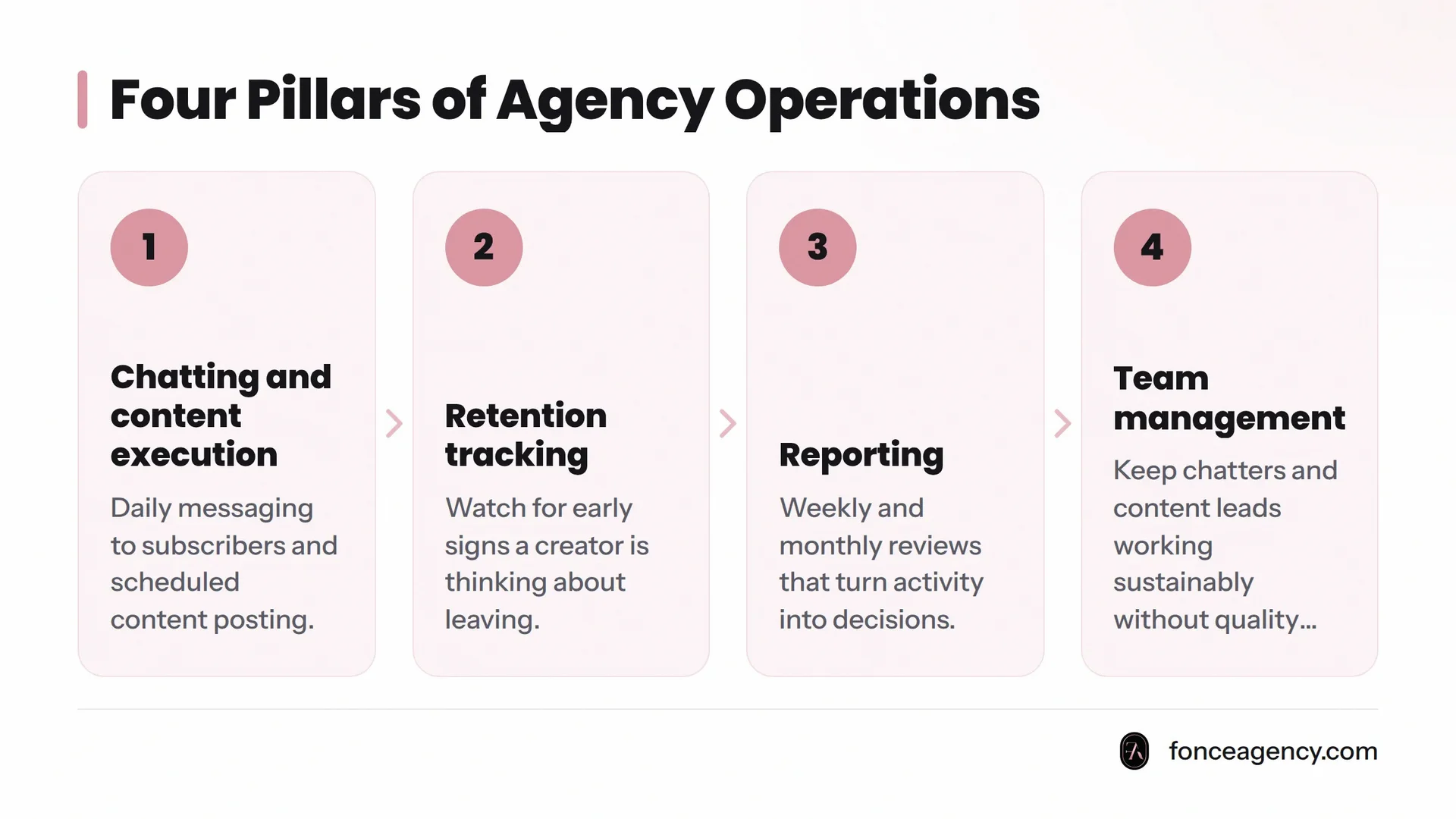
Four pillars make up this operating discipline:
- Chatting and content execution - the daily work of messaging subscribers and posting content on schedule
- Retention tracking - watching for early signs that a creator is thinking about leaving
- Reporting - weekly and monthly reviews that turn activity into decisions
- Team management - keeping chatters and content leads working at a sustainable pace without quality loss
Everything below breaks these four pillars into eight concrete steps.
Step 1: Set a Daily Operating Rhythm for Chatting and Content
A good agency day follows a rhythm your team can repeat without being told what to do next. Without structure, chatting becomes inconsistent, content gets posted late, and creators notice before anyone on your team does.
A Typical Operating Day
A working day on a managed roster breaks into three checkpoints:
Morning (first 1-2 hours): Review overnight messages, respond to any unresolved subscriber conversations, and confirm today's content is ready to post. This is also when a manager scans for anything unusual - a creator going quiet overnight, or a sudden drop in message volume.
Midday: This is the busy stretch. Chatters are handling live conversations, content posts go out at scheduled times, and the manager checks in with each chatter on volume and tone. Quality or workload issues show up fastest here if someone is paying attention.
Evening: Wrap up the day's numbers, send the creator a short note if anything needs their attention, and leave handoff notes for the next shift so nothing gets dropped overnight.
Clear Roles Prevent Dropped Balls
The most common daily failure mode is two people assuming the other one handled something. A clear split looks like this:
| Role | Owns | Checks in with |
|---|---|---|
| Chatter | Live subscriber conversations, upsells, response time | Account manager each shift |
| Content lead | Posting schedule, content vault, caption quality | Creator weekly |
| Account manager | Overall creator relationship, earnings trend, escalations | Creator and chatter team daily |
This isn't about hierarchy. It's about making sure that when something goes wrong, there's exactly one person whose job it was to catch it.
Step 2: Track the Retention Metrics That Predict Creator Churn
Creators rarely leave without showing warning signs first. The problem is that most agencies only watch earnings, which is a lagging indicator. By the time revenue drops, the creator has usually already decided something is wrong.
Leading Indicators Show Up First
Leading indicators appear before the creator tells you anything. Lagging indicators appear after the relationship has already soured. Watching only the lagging ones means you're always reacting.
- Leading indicators: slower response time to the team, missed content deadlines, shorter or clipped messages to the manager, declining engagement with posted content
- Lagging indicators: earnings drop, subscriber count decline, direct complaints, requests to pause the account
What to Watch for Early Warning Signs
In our experience running rosters, the earliest and most reliable signal is a change in communication pattern, not a change in numbers. A creator who used to reply within an hour and starts taking a day, or who used to send detailed notes about content ideas and now sends one-word answers, is usually telling you something before they've decided to tell you directly. Catching that shift early and asking a direct but low-pressure question prevents far more churn than any bonus offered after the creator is already frustrated.
| Retention signal | What it usually indicates | Recommended action |
|---|---|---|
| Response time to team doubles or more | Disengagement or competing priorities | Direct check-in call within 48 hours |
| Content submissions late two weeks running | Burnout, loss of motivation, or scheduling conflict | Review content calendar together, redistribute workload if needed |
| Earnings trend down 3+ weeks | Market or content fit issue, or subscriber fatigue | Joint review of recent content performance and chat quality |
| Fewer questions or ideas shared with manager | Reduced investment in the relationship | Open conversation about goals and satisfaction |
| Direct complaint about chatters or pacing | Active dissatisfaction | Immediate escalation to senior manager, same day |
Step 3: Run a Weekly Earnings and Performance Review With Each Creator
A weekly review is the single highest-leverage habit in running an agency well. It's the regular moment where the manager and creator both look at the same numbers and talk about what's working, rather than letting small issues pile up until they become a crisis.
Fifteen to twenty minutes is enough if both sides come prepared. What matters is consistency: the same day, the same format, every week, so the creator knows it's coming and the manager has time to prepare.
Weekly review agenda:
- Earnings this week versus last week, with a plain explanation of what drove the change
- Content performance: which posts or sets did best, and why
- Chat activity summary: volume, response time, and any subscriber feedback worth flagging
- Upcoming content calendar: is everything on track for the next seven days
- Open floor for the creator to raise anything, including concerns about chatters, pacing, or creative direction
- One agreed action item for the coming week, owned by either the manager or the creator
Keeping a short written record of these calls matters more than most agencies realize. For a template that works well as a standing format, our guide to an OnlyFans agency monthly report breaks down what creators should expect to see rolled up at the end of each month, which pairs naturally with this weekly cadence.
Step 4: Build a Communication Cadence That Prevents Burnout
Burnout on a roster rarely comes from one bad week. It builds from an operating rhythm that asks too much, too constantly, with no predictable breaks. The fix isn't a wellness program. It's a communication cadence that sets clear, sustainable expectations on both sides.
Setting Realistic Expectations
Vague expectations create constant low-grade pressure. Specific ones create predictability:
- Agree on a realistic daily content commitment the creator can sustain for months, not just for one strong week
- Set a standard response window for the creator to weigh in on content or chat questions, long enough to be reasonable
- Schedule check-ins at a fixed cadence, not only when something is wrong, so creators don't associate a call from the manager with bad news
- Build in planned downtime or lighter weeks rather than waiting for the creator to ask for a break when they're already exhausted
Burnout Patterns Worth Watching
From an operational standpoint, look for these shifts:
- A creator who was consistently proactive starts needing reminders for basic tasks
- A chatter's message quality drops during shifts, with shorter or more generic responses
- Either side starts cancelling or rescheduling planned check-ins repeatedly
- A creator mentions feeling behind or overwhelmed even when their actual workload hasn't increased
When these patterns show up, the right response is a workload conversation, not a performance warning. For a deeper look at how operations load drives creator fatigue, see our guide on creator burnout and operations load.
Step 5: Standardize Content Scheduling and Posting Workflows
Inconsistent posting is one of the fastest ways to lose subscriber momentum, and it's almost always an operations problem, not a creativity problem. A standardized workflow removes the guesswork from what gets posted, when, and by whom.
Building a Repeatable Content Calendar
A working calendar answers three questions for every piece of content: what it is, when it posts, and who is responsible for getting it live. Without that structure, content sits in a folder waiting for someone to notice it. Our OnlyFans content calendar guide walks through a weekly structure that's realistic to maintain rather than aspirational and abandoned after two weeks.
Keeping Posting Consistent Without Overloading Creators
The goal is a pace the creator can sustain indefinitely, not a sprint. A few practical habits help:
- Batch content planning a week or two ahead so creators aren't producing under last-minute pressure
- Keep a buffer of ready-to-post content so one missed shoot doesn't break the schedule
- Rotate content types so the creative demand doesn't concentrate on one format
- Review the calendar together during the weekly check-in so adjustments happen before a deadline is missed
Step 6: Monitor Chatter Quality and Rotate Workload to Avoid Fatigue
Chatters are the frontline of the subscriber relationship, and fatigue shows up in their work before it shows up anywhere else. A tired chatter sends shorter messages, misses upsell opportunities, and sounds less like the creator's authentic voice. Left unmanaged, this quietly erodes both revenue and the subscriber experience.
Quality Checkpoints for Chat Quality
Regular spot checks catch quality drift before it becomes a pattern:
- Sample a handful of conversations per shift for tone, accuracy, and responsiveness
- Confirm chatters stay consistent with the creator's established voice and boundaries
- Track response time trends per chatter, not just per account
- Flag any pattern of declining subscriber engagement that lines up with a specific shift or chatter
Rotation Schedules That Prevent Fatigue
- Cap shift length so chatters aren't handling high-volume accounts for extended stretches without a break
- Rotate chatters across accounts periodically so no single person carries the full weight of a demanding roster alone
- Build in overlap between shifts so handoffs don't create gaps where messages go unanswered
- Pair newer chatters with more experienced ones on higher-volume accounts until quality is consistent
Agencies weighing human chatters against automated tools may find our comparison on AI chatters versus human chatters useful for deciding where each fits.
Step 7: Handle Creator Feedback and Conflict Before It Escalates
Every agency relationship hits friction eventually. What separates a well-run agency from a struggling one is whether that friction gets surfaced and resolved early, or left to fester until the creator is already looking for an exit.
Creating a Feedback Intake Process
Creators need a clear, low-friction way to raise concerns that doesn't require waiting for the next scheduled review. A simple, consistent channel - a specific person, a specific message thread, a specific time they know they'll be heard - does more to prevent conflict than any formal complaint process. The key is that creators trust raising an issue won't be held against them.
De-escalation Steps for Dissatisfaction
- Listen first and confirm you understand the complaint before offering a solution
- Separate the immediate frustration from the underlying operational issue causing it
- Propose a specific, time-bound change rather than a vague promise to "do better"
- Follow up within the week to confirm the change actually addressed the concern
- Loop in a senior manager immediately if the issue touches trust, payment, or commission disputes, rather than letting a frontline team member handle it alone
Step 8: Review Agency-Wide Health Metrics Monthly
Weekly reviews catch individual creator issues. A monthly review catches patterns across the whole roster that no single weekly conversation would reveal - like a chatter team that's consistently slower on Fridays, or a content format that's underperforming across multiple accounts at once.
What to Roll Up Across the Full Roster
Monthly agency health-check checklist:
- Roster-wide earnings trend compared to the prior month, with notes on which accounts drove the change
- Retention signals flagged during weekly reviews, reviewed as a group to spot shared causes
- Chatter quality spot-check results across the team, not just individual accounts
- Content calendar adherence rate across the roster
- Open feedback or conflict items and their resolution status
- Any creator approaching a natural contract or commission review point
- Team workload balance: is any chatter or content lead consistently overloaded compared to peers
This is also the right moment to revisit your commission structure and confirm it still reflects the work each creator and team member is actually putting in, especially for creators who've grown significantly since onboarding.
Build vs. Outsourcing Your Operating Structure
Not every agency wants to run all eight of these steps entirely in-house, and that's a legitimate operating decision, not a shortcut. Some agencies keep chatting and content execution internal but bring in outside support for reporting infrastructure or overflow capacity during growth periods. Others hand off entire functions to a white label partner so their core team can focus on creator relationships instead of process management.
If you're evaluating whether to build every function yourself or lean on outside support, our page on outsourcing agency operations breaks down what a full-service white label partnership actually covers. FONCE Agency works with agency owners in both directions: supporting an existing in-house team with overflow chatting and reporting infrastructure, or running full operations under a white label OnlyFans agency partnership when an owner wants to focus on growth instead of daily execution.
FAQ
What does it actually mean to "run" an OnlyFans agency versus start one? Running an agency is the ongoing daily and weekly management of creators already on your roster: chatting, content, retention tracking, and reporting. Starting an agency covers the setup work that happens before any of that: choosing a business model, handling legal and payment setup, and signing your first creators.
What does a typical day look like for an OnlyFans agency manager? A typical day runs through three checkpoints: a morning review of overnight activity and content readiness, a midday stretch of active chatting and scheduled posting, and an evening wrap-up that reviews the day's numbers and hands off notes for the next shift.
How many creators can one manager or chatter handle at once? This depends heavily on each creator's subscriber volume, message activity, and content frequency, so there's no single number that applies everywhere. The more useful question is whether current workload is letting the team hit response-time and quality standards consistently. If it isn't, that's the signal to rebalance before adding more accounts.
What metrics predict whether a creator is about to leave an agency? Leading indicators like slower response times to the team, late content submissions, and shorter or less engaged communication tend to show up well before lagging indicators like declining earnings or a direct complaint. Watching communication patterns catches most churn risk earlier than watching revenue alone.
How often should an agency check in with each creator? A weekly structured review plus informal daily availability works well for most rosters. The weekly review covers earnings, content, and open concerns in a consistent format, while daily availability means creators aren't waiting a full week to raise something urgent.
How do agencies prevent chatter burnout? Capping shift length, rotating chatters across accounts, building overlap into shift handoffs, and running regular quality spot checks all help catch fatigue before it affects subscriber experience.
How do agencies prevent creator burnout? Setting a sustainable content pace from the start, building in planned lighter weeks, and checking in on a predictable cadence rather than only when something looks wrong all help keep workload sustainable over the long term.
What should a monthly agency health review include? It should roll up roster-wide earnings trends, retention signals flagged during weekly reviews, chatter quality results, content calendar adherence, and team workload balance, so patterns affecting multiple creators get caught instead of handled one account at a time.
What's the difference between running, scaling, and outsourcing agency operations? Running is managing the roster you already have. Scaling is growing that roster, your team, or your market reach. Outsourcing is a structural choice about whether you handle those functions in-house or through a white label partner, and it can apply at any stage, including while you're still running a smaller roster.
When should an agency consider outsourcing parts of its operations instead of running everything in-house? Outsourcing tends to make sense when internal capacity can't keep pace with chatting volume, reporting demands, or creator growth without sacrificing quality or response time. Agencies in that position often start by outsourcing one function, like overflow chatting, before considering a full white label arrangement.
Next Steps
Running an OnlyFans agency well comes down to habits repeated consistently: a daily rhythm that keeps chatting and content on track, a weekly review that catches problems while they're still small, and a monthly check that spots patterns across the whole roster before they become bigger problems. None of this requires complicated software or a large team. It requires discipline about the cadence and honesty about what the retention signals are telling you.
If you're running into the limits of what your current team can handle, or you want a partner to take on part of the operating load without losing the creator relationship, talk to FONCE Agency about operations support through our agency partnership hub.