Creators looking for the best OnlyFans management in 2026 often start by asking the wrong question. Instead of "which agency ranks first," the real question is: "which model fits where I am, what I want to accomplish, and how much control I need to keep?"
The answer depends on your stage. Full-service agencies work for creators ready to delegate entirely. Boutique managers suit niche accounts that need personalized attention. Solo managers fit tight budgets and creators who want to outsource one specific task. Hybrid setups give you a middle ground. Tool-assisted self-management keeps everything in your hands while you're still finding your voice. Let's walk through each model so you can match your account to the right fit instead of guessing.
Five Management Models: What You're Actually Choosing Between
Most agency websites claim they're the top choice without explaining what they're being compared against. That's backwards. Before anyone can rank management options, you need to understand what makes them different. There are five distinct models active in the creator economy right now. They differ in how much control you keep, how much time or money they cost, and what strategic depth they provide.
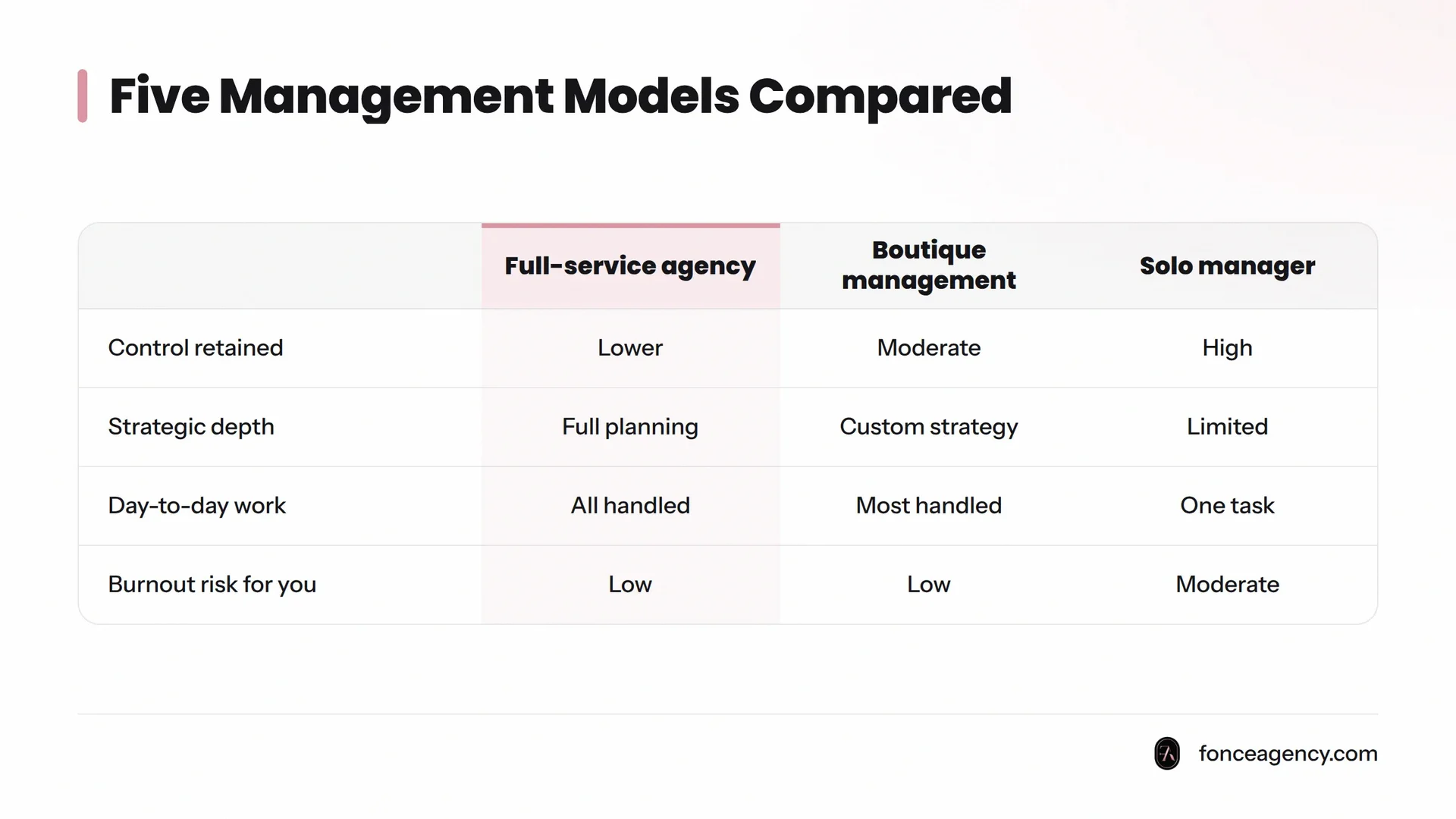
Full-service agency: A team handles strategy, subscriber chatting, content scheduling, growth, and account protection together, usually for an ongoing commission.
Boutique management: A smaller shop with a limited creator roster, offering more personal attention and custom strategy than a large agency.
Solo manager: One person, often handling a narrower task like chatting or scheduling, at a lower cost and with lower capacity.
Hybrid model: The creator keeps some tasks in-house - like content creation or brand voice - while outsourcing others, like chatting or scheduling.
Tool-assisted self-management: The creator runs everything personally, using scheduling and CRM-style software to stay organized without hiring outside staff.
None of these is universally "best." Each solves a different problem at a different stage of a creator's growth. A creator with 200 subscribers and a day job has different needs than a creator doing six figures annually who needs to protect their time. Understanding this spectrum - from maximum control and full workload on one end to full delegation on the other - is the real starting point for this decision.
How to Compare These Options
A credible comparison needs a stated rubric, not just words like "leading" or "top-performing." Here's what we weigh for each model, based on patterns from managing OnlyFans accounts at FONCE Agency:
| Criterion | What It Measures |
|---|---|
| Control retained | How much say the creator keeps over content, voice, and pricing decisions |
| Strategic depth | How much planning, data analysis, and growth strategy is built into the service |
| Operational support | How much day-to-day work - chatting, scheduling, replies - is handled for you |
| Scalability | How well the model holds up as subscriber count and revenue grow |
| Burnout risk | How likely you are to feel overworked or overwhelmed |
| Onboarding effort | How much time and setup it takes to get running smoothly |
We're intentionally leaving some details for separate conversation. We're not quoting specific commission percentages or fees here - those belong in a pricing guide where they can be thorough. We're also not ranking specific scheduling or CRM software, and we're not declaring whether hiring a manager is "worth it" in dollar terms, since that depends entirely on your numbers and goals. Those questions deserve their own dedicated space.
Full-Service Agencies: Best for Hands-Off Growth
A full-service agency suits a creator who wants an experienced team running operations, strategy, chatting, and content scheduling in exchange for giving up day-to-day control over execution.
Full-service agencies typically bundle account strategy, subscriber chatting, content scheduling, growth marketing, and account protection into one relationship. The appeal is clear: you stop being a one-person customer service department and start acting like the owner of a growing business. For creators already generating consistent revenue, a full-service team often pays off in reclaimed hours, not just dollars earned.
The tradeoff is real. Full delegation means trusting someone else with subscriber conversations, pricing decisions, and sometimes your public voice. In practice, accounts struggle most under this model when the creator never defines boundaries upfront - things like approved topics, pricing floors, or content you won't create. Creators who skip that step sometimes feel they've lost their voice, even when growth looks healthy. The fix isn't avoiding full-service management; it's choosing a partner who documents those boundaries clearly during onboarding and reports back regularly rather than disappearing behind the scenes.
Best for: Creators with existing traction who are ready to delegate operations and need a team that can scale chatting, content calendars, and growth together.
Real account trajectories from FONCE Agency case studies show what onboarding and reporting can actually look like in practice, rather than vague promises.
Boutique Managers: Best for Niche or High-Touch Accounts
Boutique management firms keep a smaller creator roster on purpose, trading the scale of a large agency for more individualized attention and custom strategy per account.
If you create in a specific niche, have an unusual brand voice, or want a manager who knows your account inside and out rather than treating it as one of fifty, a boutique shop can fit better. These teams usually offer chatting, scheduling, and strategy support, but the infrastructure is lighter. A smaller group typically wears multiple hats instead of having a large internal department for every function.
Strain shows up during growth spurts. A boutique manager handling ten accounts beautifully can struggle if that roster doubles without adding staff. Ask directly how many creators a prospective manager currently supports and whether that number is capped. It's a fair question, and any reputable boutique operation should answer it without hesitation.
Best for: Niche creators or those who value a close working relationship over large-agency infrastructure, and who are comfortable with a smaller support bench.
Solo Managers: Best for Lean Budgets and Hands-On Creators
A solo manager is one person providing OnlyFans support, usually focused on a narrower scope like chatting or content scheduling rather than full account strategy. This is the lowest-cost entry point into outside help.
This model appeals to creators who aren't ready to hand over strategic decisions but want relief from one specific time-consuming task. Many creators start here: they hire someone to handle subscriber chatting during work hours while keeping content planning, pricing, and brand voice fully in their own hands.
The real risk is capacity and consistency. One person can chat with only so many subscribers, respond to only so many messages, or manage only so many content drops before quality slips, especially during a traffic spike or viral moment. There's also a continuity risk: if your solo manager gets sick, takes a vacation, or leaves, there's often no backup. That's a meaningful difference from a model with internal redundancy. Solo management works well as a stepping stone, but it's worth revisiting the arrangement every few months as your account grows past what one person can reasonably sustain.
Best for: Creators with tighter budgets who want to outsource one specific task while keeping overall strategy and brand decisions in your own hands.
Hybrid Setups: Best for Creators Who Want Partial Delegation
A hybrid setup splits responsibilities between you and outside support, typically keeping strategy, brand voice, or content creation in-house while outsourcing operational tasks like chatting or scheduling.
This is the middle path for creators who've read horror stories about losing their voice to a management team but also know they can't personally answer every message and still have energy left to create. In a hybrid arrangement, you might keep full control over what content you produce and how you price it, while an outside partner handles subscriber chatting and daily scheduling from clear guidelines you set.
The advantage is flexibility: you can start hybrid and shift more toward full-service as trust builds, or pull tasks back in-house if something isn't working. The tradeoff is that hybrid relationships require clearer communication upfront than fully outsourced ones. Split responsibilities mean miscommunication about who owns what can create gaps - like a promotional post going out before new content is ready to be delivered.
Best for: Creators who want meaningful outside help without giving up creative or strategic control entirely, and who are comfortable setting clear task boundaries.
Tool-Assisted Self-Management: Best for DIY Creators
Tool-assisted self-management means you handle every part of the account personally, using scheduling and CRM-style software to stay organized instead of hiring outside staff.
This is often where new creators start, and it's completely reasonable. You're testing your niche, finding your voice, and learning what your subscribers respond to. Paying for outside help before you understand your own content and audience can mean paying for strategy that doesn't fit you yet. Software helps here by automating content posting schedules, tracking subscriber messages, and organizing promotional campaigns without requiring you to hand over account access to anyone.
The limit of this model is time and energy. Chatting with subscribers, posting consistently, promoting across social platforms, and creating new content is a full workload on its own. Most creators who grow past a certain point find they physically cannot sustain all of it alone without burning out, missing promotional windows, or letting subscriber retention slip because replies get delayed.
Best for: Brand-new creators still building their niche and audience, or established creators testing a new account who aren't ready to bring in outside support yet.
Side-by-Side Comparison
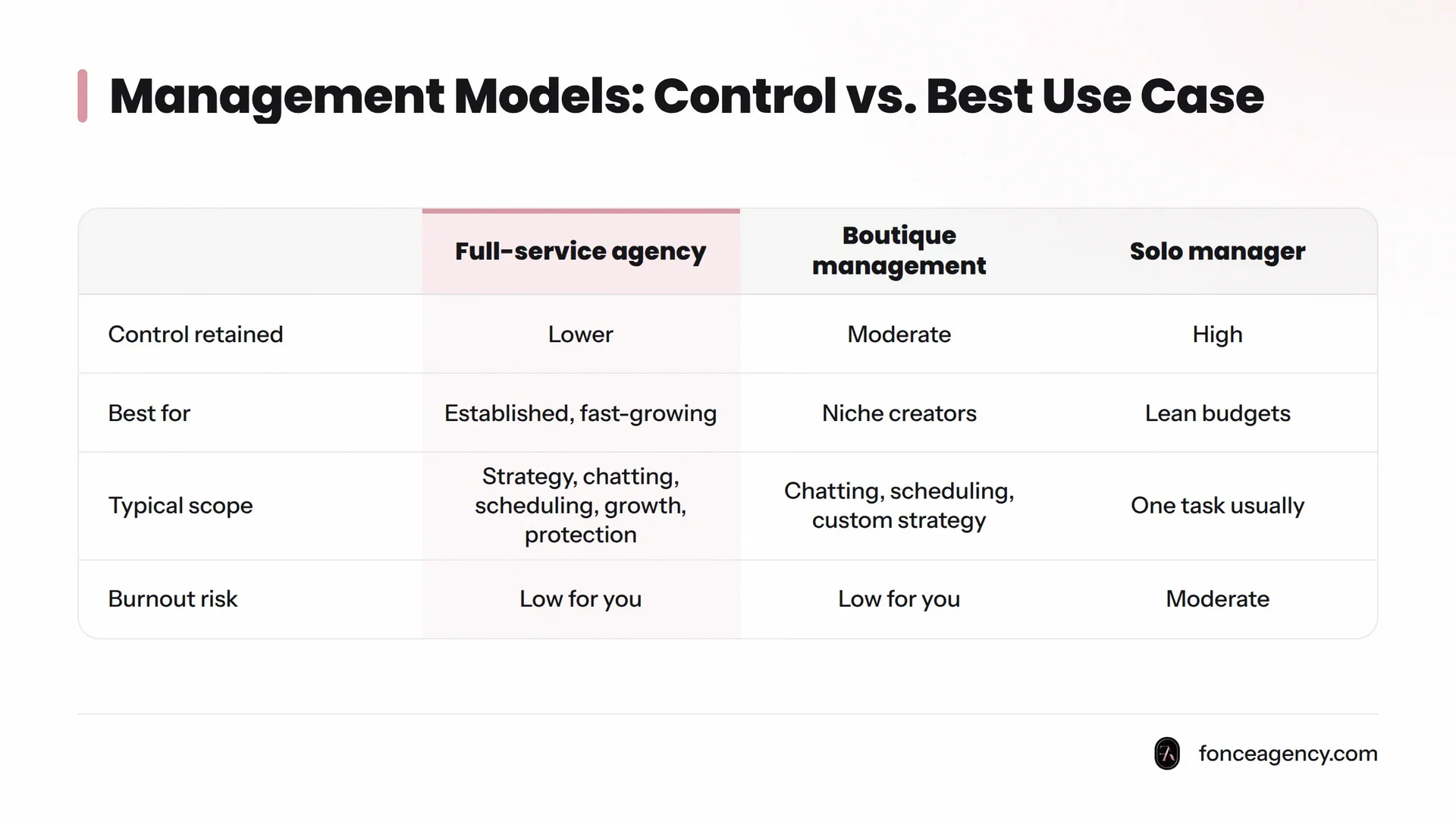
| Model | Control Retained | Best For | Typical Scope | Burnout Risk |
|---|---|---|---|---|
| Full-service agency | Lower | Established or fast-growing creators ready to delegate | Strategy, chatting, scheduling, growth, protection | Low for you; moderate for team if roster is overloaded |
| Boutique management | Moderate | Niche creators wanting high-touch attention | Chatting, scheduling, custom strategy, smaller roster | Low for you; rises if boutique scales too fast |
| Solo manager | High | Lean budgets, creators keeping strategy in-house | Usually one task, like chatting or scheduling | Moderate; limited by one person's capacity |
| Hybrid setup | High | Creators wanting help without full delegation | Split: you keep some tasks, outsource others | Moderate; depends on clarity of task boundaries |
| Tool-assisted self-management | Highest | Brand-new creators or DIY-minded operators | Everything, supported by scheduling/CRM software | Highest; you do all the work |
Finding the Right Model for Your Stage
The right model usually tracks closely with where you are in your creator journey, not just your budget.
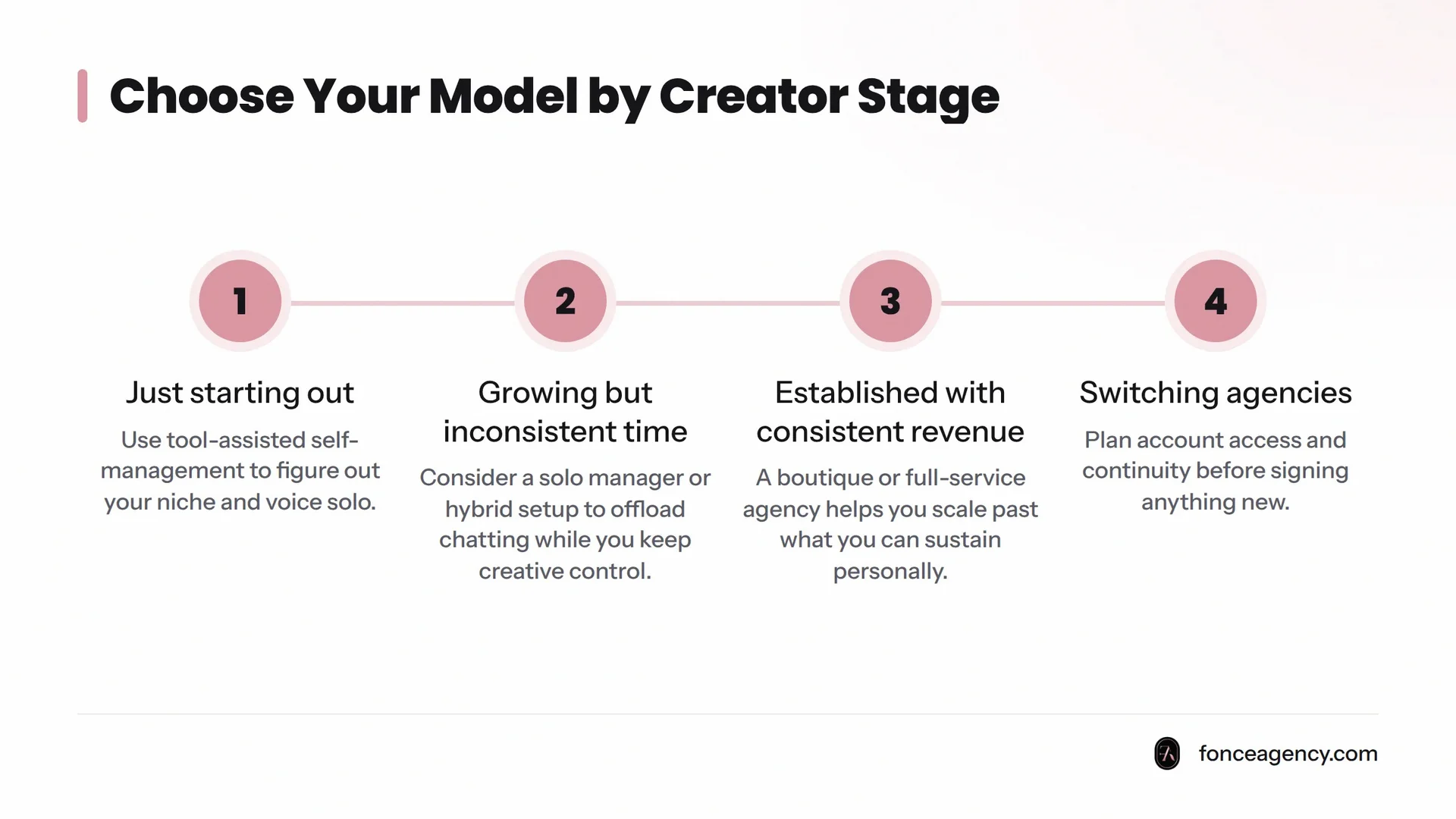
Just starting out: Lean toward tool-assisted self-management while you figure out your niche, voice, and content rhythm. There's no shame in doing this stage solo, and it builds knowledge you'll use no matter what you choose later.
Growing but inconsistent time: Consider a solo manager or hybrid setup to offload the most time-consuming task - usually chatting - while you keep creative and pricing decisions.
Established with consistent revenue: A boutique or full-service agency can help you scale past what you can sustain personally, especially once subscriber volume makes chatting and scheduling a full-time job on its own.
Switching from one agency to another: This has its own process and risks around account access and continuity. Ask the right questions before you sign anything new.
Reviewing real account trajectories rather than promises often clarifies what a realistic transition looks like at each stage. Looking at actual creator results from accounts that moved between models is more informative than any generic timeline.
One honest note from operational experience: creators rarely burn out because they chose the "wrong" model in some absolute sense. They burn out when their model stops matching their current reality - a solo chatting setup that worked at 500 subscribers breaks down at 5,000. Revisiting your setup every few months, rather than locking into one model forever, prevents that mismatch before it becomes a crisis.
Common Questions About OnlyFans Management
What does OnlyFans management usually include? Most arrangements cover some combination of subscriber chatting, content scheduling, account strategy, growth and promotion support, and basic account protection. The exact mix depends heavily on the model: full-service agencies bundle all of it, while solo managers often handle just one piece.
Is full-service management better than a solo manager? Neither is universally better. They solve different problems. Full-service management suits creators ready to delegate broadly and who have the volume to justify a full team, while a solo manager suits creators who want to outsource one specific task while keeping the rest in-house.
Will a manager take over my account? A reputable arrangement should operate within boundaries you set during onboarding, including pricing floors, content limits, and approval processes for your voice and brand. Ask any prospective manager directly how account access and decision-making authority are handled before you commit.
How soon should I see results from management? Timelines vary by your starting point, niche, and how established the account already is, so be cautious of anyone promising a specific number or timeframe upfront. A better early signal is whether your management partner is communicating clearly, following the strategy they proposed, and reporting progress on a consistent schedule.
Next Steps: Finding Your Best Fit
Picking a management model isn't about finding the agency with the biggest claims. It's about being honest with yourself about your current stage, how much control you want to keep, and how much time you're realistically willing to spend on tasks like chatting and scheduling versus creating. The five models above aren't competitors fighting for the same creator; they're tools that fit different moments in a creator's growth.
If you want help figuring out exactly where your account fits, FONCE Agency offers a free consult to walk through your current setup and map it against the right model for your stage. You can also browse how OnlyFans management works at FONCE or look through real account results in case studies before you decide anything. There's no pressure to pick full-service just because it's the most visible option. The best choice is the one that fits your account today, with room to change as it grows.