OnlyFans PPV Messages: A Step-by-Step Strategy
Learn how to build an OnlyFans PPV strategy that boosts unlock rates with fan segmentation, tease copy, and smart sequence timing.
Jump to a section
On OnlyFans, a PPV (pay-per-view) message is a direct message containing content locked behind a paywall. Fans pay individually to unlock it, separate from their subscription tier. The interface itself is simple: compose, attach, set a price, choose recipients, send. What separates a successful PPV strategy from one that tanks unlock rates isn't the mechanics of sending - it's everything around that single click.
A PPV strategy decides who gets what, when, and why. Done well, it feels like reading the room and saying the right thing at the right moment, not like sending sales pitches to a list. The difference is real. Most creators already know how to send a PPV. The missing layer is understanding who should receive it, what copy will create a reason to unlock, how often to send without burning out the audience, and what to do when unlock rates drop.
This guide builds that system step by step.
What Makes a PPV Convert
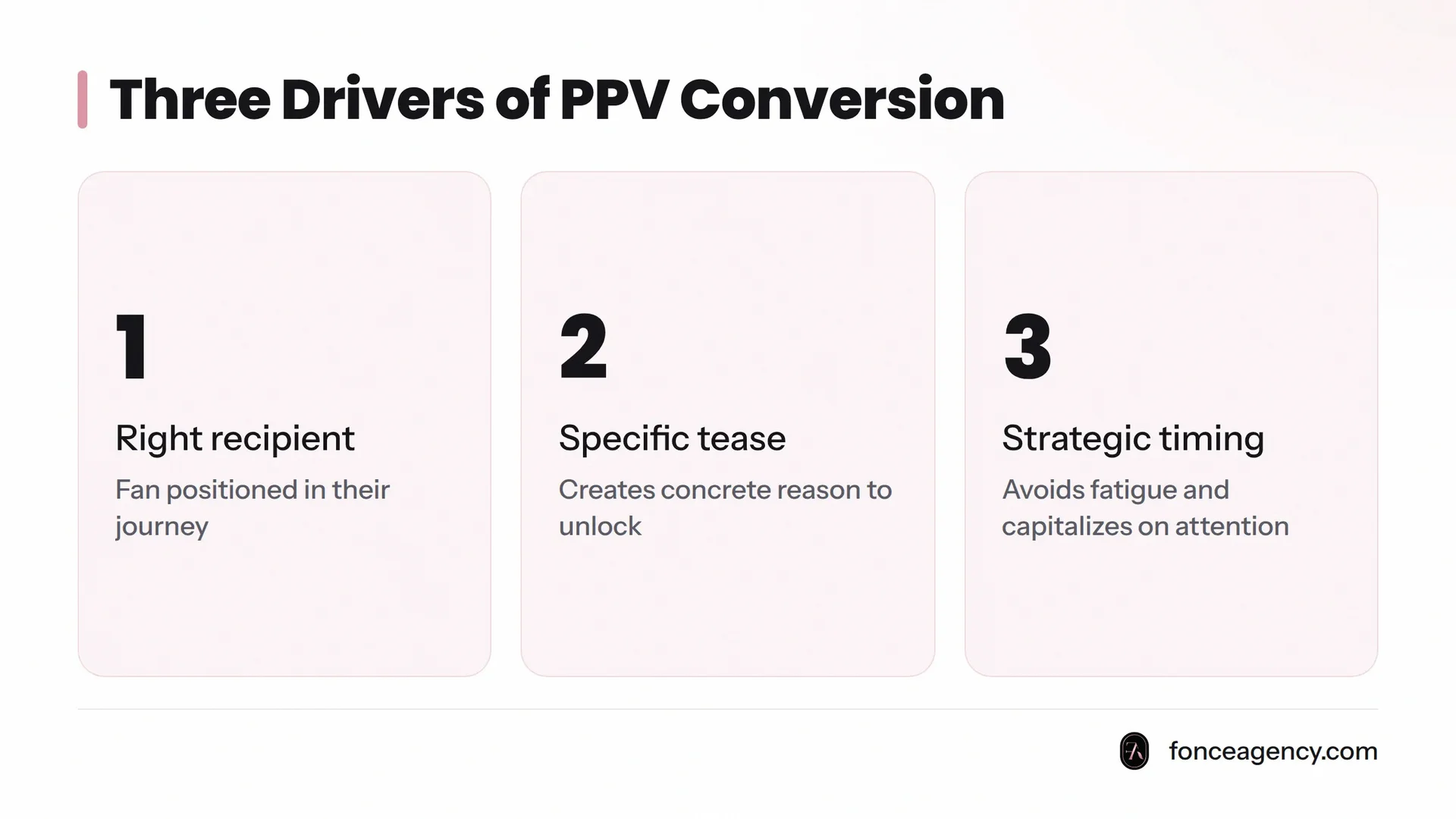
A PPV that performs has three things working together: the right recipient, a tease that creates a specific reason to unlock, and timing that doesn't collide with fatigue. Strip out any one of those three and the same content performs differently.
The clearest signal for whether segmentation, tease copy, and timing are working together is unlock rate - the percentage of recipients who pay to view a given PPV. It's the single metric that most directly reflects the health of a messaging strategy, and nearly everything in this guide ties back to protecting or improving it.
Step 1: Map the Fan Journey Before Sending
Before any message goes out, know where each fan actually sits in their relationship with the account. Sending the same PPV to a brand-new subscriber and a two-year regular treats two different relationships as identical, which is one of the most common reasons sequences underperform.
Recognizable Fan Stages
Most fans fall into one of a few clear positions:
- New subscriber: joined recently, still forming an opinion about whether the account deserves their continued attention and money.
- Engaged non-buyer: opens messages, reacts, maybe tips occasionally, but hasn't unlocked a PPV yet.
- Repeat buyer: has unlocked before, meaning trust and purchase intent are already established.
- Lapsing fan: was active, has gone quiet, and needs a different message than a straight sales send.
Each group needs a different approach. A new subscriber usually needs warmth and context before any paywall appears. A repeat buyer can often handle a more direct offer because the relationship has already passed that test.
Why Journey Mapping Prevents Wasted Sends
Skipping this step leads to a common pattern: a flat, one-size-fits-all cadence like "send once a month to everyone" or "three messages a week no matter what." That doesn't fail because the frequency is wrong; it fails because it ignores that a list full of different relationships shouldn't receive identical messages.
Quick reference checkpoints:
- Has this fan unlocked anything before? If not, is it low funds, the wrong offer, or insufficient trust?
- When did they last open a message, and when did they last pay for anything?
- Are they still responding to free sends, or has engagement gone quiet?
- Does their spending history suggest a higher-tier offer or something lower-commitment?
Step 2: Build Your Sequence Structure
Once a fan's position in the journey is clear, the next step is deciding how messages build on each other over time. This is sequence or drip messaging: a planned series of messages, spaced and ordered deliberately, rather than isolated PPVs sent whenever inspiration strikes.
Segmenting by Spender Behavior
Not every fan should move through the same sequence at the same pace. Group fans into tiers based on how they've actually behaved, not how you'd like them to behave:
| Spender tier | Typical pattern | Sequence treatment |
|---|---|---|
| Whale | Unlocks quickly, spends above average, responds to direct offers | Can handle more frequent, higher-value PPVs; benefits from exclusivity and personal attention |
| Regular | Unlocks occasionally, needs some warm-up before a paywall | Benefits from a short tease-and-build sequence rather than an immediate offer; moderate frequency |
| Low spender | Engages with free content, rarely or never unlocks | Needs longer relationship-building before offers; lower frequency, lower-pressure framing, smaller asks |
This framework avoids wasting a whale-caliber offer on someone who's shown no buying signal yet, and avoids under-serving a fan clearly ready for more.
Buyer vs. Non-Buyer Follow-Up
After any PPV send, the list splits naturally into two groups, each needing a different response:
- Buyers can often move toward the next offer sooner, since they've just demonstrated intent. A short, warm acknowledgment followed by a related next tease tends to perform better than silence.
- Non-buyers usually need something other than an immediate second offer. That might mean a lighter free message to re-engage attention, a different angle on the same content, or simply more time before the next ask.
Treating these groups identically is a common pattern behind declining unlock rates over time: buyers get ignored at their most receptive moment, and non-buyers get re-pitched the same thing that didn't land the first time.
How Sequences Work
A basic sequence might flow like this: a free or low-friction message to re-establish contact, a tease that builds curiosity, the PPV itself, and then a follow-up branch depending on whether it unlocked. The sequence, not the single message, becomes the unit of strategy. This is particularly important when someone trained in voice management is running sends on the account - consistency between multiple writers is its own skill set.
Step 3: Write Tease Copy That Earns the Click
The tease is the message immediately before the paywall. Its only job is to create a specific, concrete reason to pay, not a generic one.
What Tease Copy Needs to Do
A tease message needs to confirm the fan is being spoken to as an individual, not a broadcast list; give a specific detail about what's behind the paywall rather than a vague promise; and match the energy of whatever conversation led up to it. A tease that could have been sent to anyone, at any time, in any conversation tends to produce flat unlock rates regardless of how good the actual content is.
Keeping Voice Consistent Across Sends
When more than one person is writing messages on an account, voice drift becomes a real risk. A fan used to a certain tone, word choice, and pacing will notice when a message suddenly reads differently, and that inconsistency quietly erodes trust even when the fan can't articulate what feels off. Maintaining a documented voice guide, reviewing message samples regularly, and setting clear escalation rules for who approves new copy keeps a sequence feeling like one continuous relationship rather than a rotating cast of writers.
Tease-Writing Checklist:
- Does this reference something specific to the conversation, not a copy-paste line?
- Does it build one concrete detail of curiosity rather than several vague ones?
- Does the tone match the last few messages in the thread?
- Would this still make sense if the fan read the last five messages before it?
Step 4: Time and Space Your Sends
Even a well-segmented, well-written sequence can underperform if timing is wrong. Cadence is where good strategy most often turns into overselling fatigue.
Send Cadence and Fatigue
There's no universal number of PPVs per week that works for every account, because cadence depends on list size, spender mix, and how recently a fan has been asked to pay. What holds steady across accounts is the underlying principle: every send has a cost, even when it doesn't convert, because it uses up a small amount of the fan's attention and goodwill. A cadence that ignores this treats every send as free, which it isn't.
Timing Around Fan Activity
A message sent during a fan's typical active window has a real chance of being seen quickly; the same message sent at a dead hour might sit unopened long enough that the moment and the curiosity built by the tease have passed. Spacing also applies within the sequence itself: back-to-back asks with no breathing room between them are a common cause of muting or unsubscribing, even when the individual messages were well written.
Step 5: Read the Response and Adjust
A PPV sequence isn't something to set and forget. Every send produces information, and that information should change what happens next.
What Unlock Rate Is Telling You
Unlock rate reflects the combined effect of segmentation, tease copy, and timing, not any one of those three in isolation. A dropping unlock rate doesn't automatically mean the content was wrong; it might mean the wrong tier received the offer, the tease didn't land, or the send landed at a bad moment. Reading the trend over several sends, rather than reacting to a single data point, gives a clearer picture of what's actually happening.
When to Re-Segment, Re-Time, or Re-Write
If unlock rates are sliding across more than one send in a row, isolate which variable likely moved first. Did the recipient list change - new subscribers diluting a previously well-segmented group? Did the tease style shift, maybe a new chatter entered without a full brief? Did the send time change, perhaps shifting to accommodate a different time zone?
If unlock rate drops, check these first:
- Has the recipient segment changed, with more new or lower-intent fans mixed into a list that used to be mostly buyers?
- Has the tease copy drifted from what's worked before, in tone, specificity, or length?
- Has the send cadence increased recently, risking fatigue rather than anticipation?
- Has the send timing shifted away from when this segment is typically most active?
Working through these four in order, rather than rewriting the whole sequence at once, makes it much easier to tell what actually fixed the problem.
Restructured Sequence in Action
The following example is illustrative, built to show how the same underlying content and list can perform differently once the sequence is restructured. It's a pattern frequently seen when accounts move from a flat, one-size-fits-all approach to a segmented one.
| Element | Generic sequence (before) | Restructured sequence (after) |
|---|---|---|
| Recipient list | All subscribers, single mass message | Split by spender tier; whales and regulars get distinct tease framing |
| Tease copy | Same generic line sent to everyone ("you'll love this one") | Tease references the specific conversation or recent interaction with that fan group |
| Timing | Sent at one fixed time regardless of list activity patterns | Staggered by typical activity windows for each segment |
| Buyer follow-up | No distinct follow-up; same cadence continues for everyone | Buyers receive a warm acknowledgment and a related next offer sooner |
| Non-buyer follow-up | Re-sent the same or a similar offer shortly after | Shifted to a lighter, relationship-building message before any new offer |
| Cadence | Fixed schedule regardless of recent send history | Adjusted based on how recently that segment was last messaged |
The shift isn't about sending more messages. It's about making each one land on someone who's actually ready for it.
Revenue Sends vs. Sustainable Relationships
There's a real tension in PPV strategy: revenue sends are necessary, but a list that only ever hears from an account when it wants something will eventually stop listening.
Warning Signs of Overselling Fatigue
A few patterns tend to show up before a list's response rates collapse outright:
- Unlock rates trending down across several consecutive sends, not just one weak week
- A noticeable rise in unsubscribes that cluster shortly after PPV-heavy periods
- Fans who used to engage with free messages going quiet entirely, not just skipping paid offers
- Replies shifting from warm or playful to short and transactional
- A growing share of the list muting messages rather than unsubscribing outright, which is often an earlier warning sign than a cancellation
Balancing Revenue Sends With Relationship-Building
The accounts that sustain strong unlock rates over time tend to treat free, no-ask messages as part of the strategy rather than filler. A message that checks in, reacts to something the fan said, or shares a small free moment keeps the relationship warm between asks, so that when a PPV arrives, it lands inside an existing conversation rather than interrupting silence with a sales pitch. The goal isn't fewer PPVs - it's a healthier ratio between asking and connecting.
Putting the Strategy Into Practice
Here's the five-step framework in order:
- Map the fan journey so every send starts from an accurate read of where that relationship actually stands.
- Build the sequence structure, segmenting by spender tier and branching based on buyer versus non-buyer behavior.
- Write the tease so it earns the unlock instead of just announcing the paywall.
- Time and space the sends to work with fan activity patterns instead of against them.
- Read the response and adjust, using unlock rate as the signal that tells you what to change next.
This framework works best as a loop, not a checklist to complete once. Each sequence informs the next, and adjustments compound over time into a messaging rhythm that fans actually look forward to rather than tolerate.
For creators who want hands-on help putting this into practice, FONCE Agency works directly inside accounts every day refining exactly this kind of sequence. The agency's OnlyFans chatting services run sequences in a creator's own voice rather than a generic script, and OnlyFans mentorship and growth consultation offers direct guidance for creators building out their own systems.
If you're earlier in the process and still building out the surrounding content and promotion that feeds a healthy PPV list, it's worth looking at how OnlyFans marketing built around retention, rather than one-off promotion, changes how much a messaging strategy like this one can accomplish.
Frequently Asked Questions
What is a PPV message on OnlyFans? A PPV, or pay-per-view, message is a direct message containing content locked behind a paywall that a fan pays individually to unlock, separate from their subscription.
How is a PPV message different from a regular mass message? A regular mass message is typically free content sent broadly to maintain engagement, while a PPV message asks the recipient to pay before viewing the attached content.
How do I send a message on OnlyFans? Within the OnlyFans creator dashboard, open the messaging interface, compose a message, attach the content, set a price if it's a PPV, choose individual or mass recipients, and send.
How much do OnlyFans messages cost? Pricing for PPV messages is set individually by the creator for each send. For guidance on how to approach pricing decisions, see the OnlyFans pricing guide.
What does "No PPV" mean on OnlyFans? "No PPV" typically appears in a creator's bio or profile to signal that they don't sell locked pay-per-view content, usually because their monetization relies solely on subscriptions, tips, or custom requests instead.
Can OnlyFans do automated messages? OnlyFans supports scheduled and mass messaging through its creator dashboard, but full automation of personalized sequences generally depends on how a creator or their chat team manages timing and segmentation manually or with outside tools.
How often should I send PPV messages to my fans? There's no fixed number that works for every account. Cadence should follow each fan segment's recent activity and purchase history rather than a flat schedule applied to the whole list.
What is an unlock rate and why does it matter? Unlock rate is the percentage of message recipients who pay to view a PPV, and it's the clearest single signal of whether segmentation, tease copy, and timing are working together.
How do I segment fans before sending a PPV? Group fans by behavior - such as new subscriber, engaged non-buyer, repeat buyer, or lapsing fan - and by spending pattern - such as whale, regular, or low spender - then tailor the offer and tone to each group.
What's the difference between a whale, a regular, and a low spender? A whale unlocks quickly and spends above average. A regular unlocks occasionally and needs some warm-up. A low spender engages with free content but rarely or never pays to unlock.
How should my PPV sequence differ for buyers vs. non-buyers? Buyers can typically move to a related next offer sooner since they've just shown intent, while non-buyers usually need a lighter, relationship-focused message before facing another ask.
What makes a tease message effective before the paywall? An effective tease references something specific to that conversation, builds one concrete detail of curiosity, and matches the tone of the recent messages around it.
How do I keep chatter voice consistent across PPV sends? Document the account's voice guidelines, review message samples regularly, and set clear rules for who can write and approve new copy so the tone doesn't drift between writers.
How do I know if I'm sending PPVs too often? Watch for unlock rates declining across several consecutive sends, rising unsubscribes clustered after PPV-heavy periods, and fans going quiet even on free messages.
What are the warning signs of overselling fatigue? Falling unlock rates over consecutive sends, unsubscribe spikes after heavy PPV periods, disengagement from free content, shorter and more transactional replies, and a rising rate of muted conversations.
How do I read fan response data to adjust my next send? Look at the trend across multiple sends rather than one data point, then check segmentation, tease copy consistency, recent cadence, and timing in that order to isolate what likely changed.
What should I check first if my unlock rate drops? Start with whether the recipient segment has shifted, then review tease copy consistency, recent cadence, and whether send timing still matches that segment's activity pattern.
How does a PPV sequence differ from a single PPV send? A single send is one isolated message, while a sequence is a planned series of messages, spaced and ordered deliberately, where each message's performance informs the next.
Should new subscribers get PPVs right away or later in the journey? New subscribers generally benefit from warmth and context before any paywall appears, since trust hasn't been established yet. That early groundwork connects closely to how the welcome message itself is written.
How does pricing fit into a PPV strategy without setting specific prices? Pricing decisions sit alongside sequence strategy rather than inside it. The sequence determines who sees an offer and when, while a dedicated pricing guide addresses how much to charge.
Why do some PPV messages get deleted before fans see them? Message deletion involves separate platform and moderation factors outside the scope of sequence strategy and is better addressed on its own.
Can a chatter run a full PPV sequence, or does the creator need to be involved? A trained chatter can run a full sequence when they're working from clear voice guidelines and segmentation data, which is why many creators choose to hire chatters specifically for this kind of ongoing messaging work.
What's a realistic way to balance revenue sends with relationship-building messages? Treat free, no-ask messages as a regular part of the mix rather than filler, so PPVs land inside an already warm conversation instead of breaking a long silence with a sales pitch.
Next Steps
PPV messaging works best as a system that's built once and refined continuously, not a tactic reached for whenever revenue dips. Start with the five steps in order, measure unlock rate honestly, and let the response data decide what to adjust next.