OnlyFans Agency Fees: What You Might Be Charged
Setup, onboarding, marketing, software, and exit fees can all hide behind an agency's commission rate. Here's what to ask before you sign.

Jump to a section
If an OnlyFans agency has sent you a proposal, commission is only the beginning. Beyond the revenue-share percentage, agencies can charge setup fees, onboarding or training fees, content creation and marketing add-ons, software or tool pass-throughs, minimum monthly fees, and exit or buyout fees when you leave. None of these are inherently wrong, but every one should be in writing before you sign anything.
This guide focuses on everything beyond commission percentages, what each charge actually means, and which patterns should make you pause before signing a creator management agreement.
What Counts as an OnlyFans Agency Fee?
An OnlyFans agency fee is any charge beyond the core revenue share. Agencies earn through one of two models, or a blend of both: a commission (a cut of what you earn) or a flat fee (a fixed retainer regardless of earnings). Either model can come bundled with extra charges, and that's where confusion typically starts.
The key distinction: fees can exist alongside commission, or they can replace it entirely. A pure commission agency might charge 20 to 50 percent of earnings and nothing else. A flat-fee agency charges a set monthly rate with no revenue share. A hybrid agency charges a lower commission plus add-on fees. None of these structures is inherently better; the total cost only becomes clear when every fee is itemized side by side.
Common Fee Types Agencies Charge
Most creators are surprised to learn how many separate line items can appear in an agency contract. Some reflect standard industry practice. Others are negotiable or avoidable. Here's what to expect and what to ask about:
| Fee Type | What It Covers | When It's Charged | What to Ask |
|---|---|---|---|
| Setup fee | Account setup, profile optimization, initial strategy build | One-time, at signing | "Is this refundable if I cancel in the first 30 days?" |
| Onboarding / training fee | Orientation calls, training materials, workflow setup | One-time, early in the relationship | "What exactly does this fee buy me?" |
| Content creation fee | Photo/video production support, editing, content planning | Per project or ongoing | "Is this billed per piece or as a flat add-on?" |
| Marketing/promotion fee | Paid traffic campaigns, collab outreach, promo budget | Ongoing or per campaign | "Is the ad spend itself included, or billed separately?" |
| Chatting service fee | Direct message sales and fan engagement staffing | Ongoing, often commission-based itself | "Is this a separate percentage from my management commission?" |
| Software/tool fee | Chat platforms, scheduling tools, analytics dashboards | Monthly pass-through | "Is this billed at cost, or marked up?" |
| Minimum monthly fee | A guaranteed baseline payment to the agency regardless of your earnings | Monthly, often in slow months | "What happens if my earnings fall below this threshold?" |
| Exit/buyout fee | A charge for ending the contract early or transferring your account | At termination | "Does this fee apply even after my contract term ends?" |
A few of these deserve closer attention, since they're the ones creators most often say they wish had been explained upfront.
Setup, Onboarding and Training Fees
A setup fee is a one-time charge for getting your account ready: profile audits, bio rewrites, pricing strategy, and initial content organization. An onboarding fee (sometimes called a training fee) covers orientation calls, workflow explanations, communication expectations, reporting cadence, and tools you'll use.
Neither fee is unusual. What matters is specificity. A legitimate setup fee should come with a clear description of deliverables, not just a number on an invoice. If an agency can't tell you what the fee actually covers, that's worth questioning.
Content, Marketing and Tool Fees
Content Creation Fees
A content creation fee covers production support: shoot planning, editing, or packaging content into sellable sets. Some agencies fold this into their core commission. Others bill it separately, especially when providing production support beyond standard management, like coordinating a shoot or hiring an editor on your behalf.
Marketing and Promotion Fees
A marketing or promotion fee funds subscriber growth activities: paid traffic, collaboration outreach, or promotional campaigns. The fee might be flat, a percentage of ad spend, or project-based. The critical distinction is whether the fee covers the agency's labor only, or also includes media spend itself. Those are very different numbers, and conflating them is a common source of confusion.
Software or Tool Fees
Agencies use chat management platforms, scheduling software, and analytics dashboards across their creator roster. When those costs get passed to you, that's a software or tool fee, also called an expense pass-through. The most important question is whether the agency passes costs through at actual rate or adds a markup. Both are common in service industries, but you deserve to know which one applies to you.
Chat staffing compensation structures, whether built into commission or billed separately, involve enough nuance to deserve dedicated explanation rather than a summary here.
Exit, Buyout and Early-Termination Fees
An exit fee is a charge for ending your contract early or leaving the relationship entirely. A buyout clause is contract language defining what you owe if you terminate early or move your account elsewhere, sometimes framed as a percentage of projected future earnings or a flat penalty.
These clauses matter more than almost any other fee type, because they determine what it actually costs to leave if the relationship isn't working. A creator management agreement without a clear exit clause is a red flag in itself. You should know exactly what triggers an exit fee, how it's calculated, and whether it applies if the agency fails to deliver on its own commitments before you sign. Clause-by-clause contract review is a legal matter best handled with a professional, but understanding what to look for is step one.
Patterns Worth Questioning
Not every fee is problematic, but certain patterns show up consistently in creator complaints about agency billing:
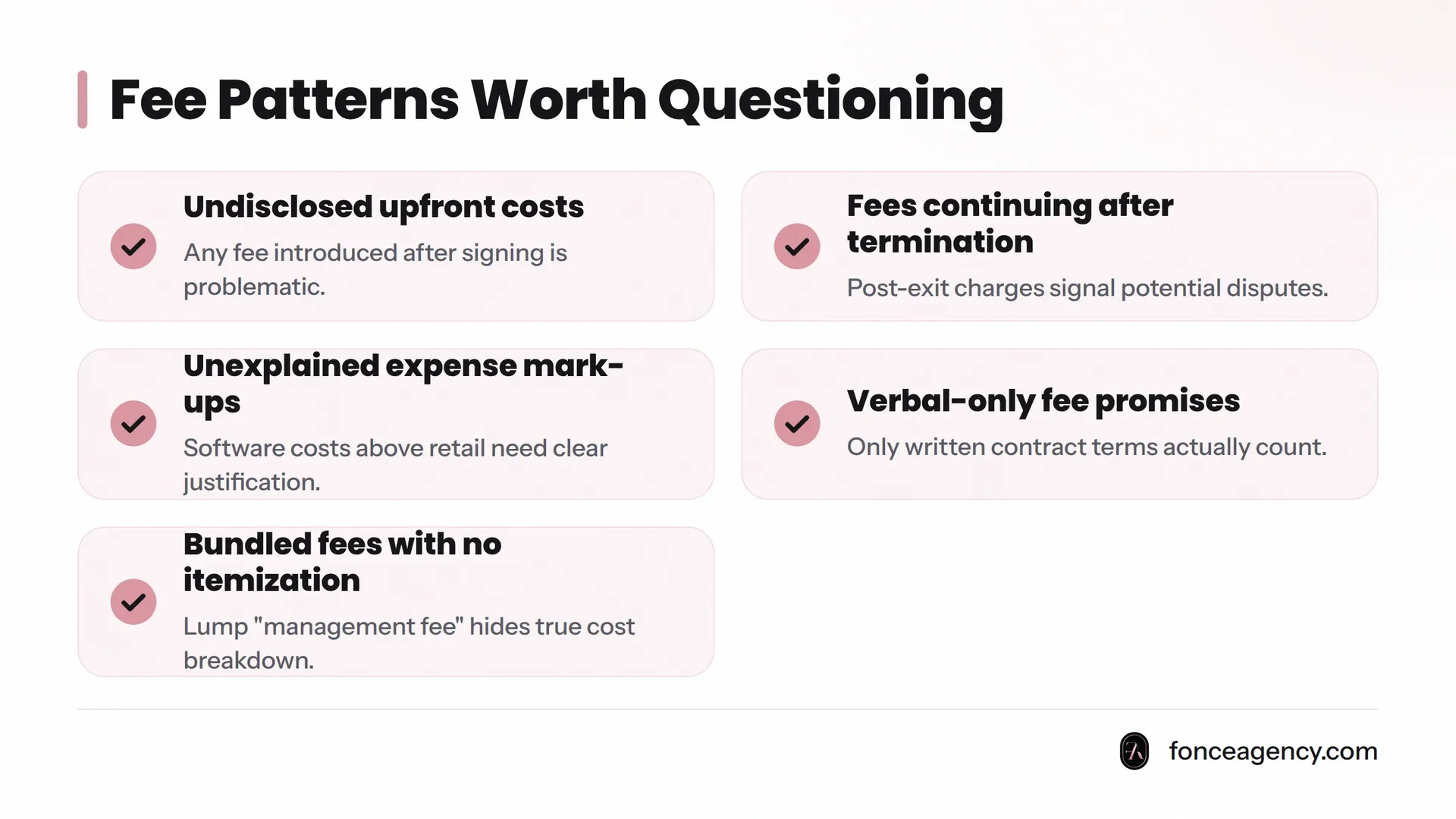
- Undisclosed upfront costs. Any fee introduced after signing, rather than disclosed beforehand, is a problem regardless of the amount.
- Fees that continue after termination. Charges appearing after you've left the agency aren't standard practice and signal a dispute waiting to happen.
- Unexplained expense mark-ups. Software or tool costs billed well above retail rate, with no explanation, deserve a direct question.
- Verbal-only fee promises. If a fee was described on a call but never appears in writing, the written contract is the only version that counts.
- Bundled fees with no itemization. A single lump "management fee" supposedly covering five services, with no breakdown, makes it impossible to know what you're actually paying for.
The U.S. Federal Trade Commission's guidance on clear and conspicuous disclosure in service agreements establishes a useful standard: material terms, including cost, should be disclosed in a way that's easy to find and understand, not buried in fine print. While that guidance is written for advertising, the underlying principle - that costs should be clear before someone commits - applies directly to agency contracts.
Questions to Ask Before Signing
Bring this list into any discovery call with an agency:
- Can you give me every fee in writing before I sign anything?
- Is there a setup or onboarding fee, and exactly what does it cover?
- Do any fees continue after I leave or terminate the contract?
- Are software or tool costs passed through at cost, or marked up?
- Is there a minimum monthly fee, and what happens if I don't hit it?
- Is the chatting service billed separately from management commission?
- What triggers the exit or buyout clause, and how is that amount calculated?
- Can I see an itemized invoice example before I commit?
- Are marketing fees separate from actual ad spend, or combined?
- If my earnings drop, do any fees stay fixed regardless?
A reference-check process surfaces how an agency actually behaves on billing. Speaking directly with past or current clients tends to reveal more than any sales call will.
Before You Sign
Request an itemized fee schedule in writing, not a verbal summary. Read the termination section of the contract specifically for exit fees or buyout language. Ask to see a sample monthly report so you understand what gets reported alongside billing.
If you're comparing offers, look for agencies that put every fee in writing upfront, with no bundled surprises and no charges appearing after you've already signed. Compare total cost across proposals, not just headline commission numbers.
Frequently Asked Questions
Do OnlyFans agencies charge upfront fees? Some do, in the form of setup or onboarding fees charged at signing. This is not universal across the industry and isn't inherently a red flag, but any upfront fee should be disclosed clearly before you sign with a plain description of what it covers.
What are hidden fees to look out for? The most common hidden-fee patterns are charges introduced after signing that weren't in the original proposal, software costs marked up without disclosure, fees that continue after termination, and bundled "management fee" line items with no itemized breakdown.
Is a setup fee normal in an OnlyFans agency retainer? A setup fee appears in some agency pricing models and not others. It becomes a concern when undisclosed until after signing or when the agency can't clearly explain what work the fee covers.
Can an agency charge fees after I leave? Only if the contract specifically states that certain fees survive termination, typically tied to an exit or buyout clause. Fees that continue with no contractual basis after you've formally ended the relationship are not standard practice and should be challenged.
Can an agency charge both commission and a flat fee? Yes. This hybrid pricing model pairs a lower commission percentage with one or more flat add-on fees, like a retainer, setup charge, or software pass-through. It's common enough that it shouldn't surprise you, but the combined total should still be disclosed clearly.
What's the difference between a retainer and a flat fee? In practice the terms are often used interchangeably for a fixed recurring charge. Some agencies use "retainer" specifically for a baseline monthly payment that secures a set amount of work, while "flat fee" can refer to either a recurring charge or a one-time project rate. Ask the agency directly which definition applies to your contract.
Understanding fee structures is one piece of a larger decision. If you're still weighing whether agency management fits your situation, get clarity on the service itself before diving deep into contract terms. Getting the fee structure right matters, but it only matters once you've confirmed the service fits your goals.
Related: OnlyFans management, questions to ask before choosing an agency